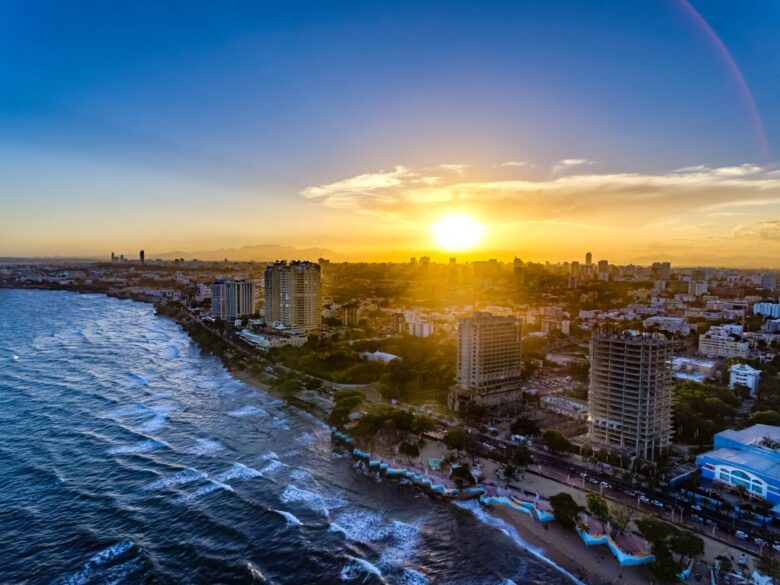
Rising 67 meters above the city, the Monument to the Heroes of the Restoration (Monumento a los Héroes de la Restauración) is Santiago de los Caballeros’ defining landmark — visible from virtually anywhere in the Cibao Valley. It’s the city’s symbol, its highest point, and the centerpiece of any visit to Santiago.
Inaugurated in 1944, the monument commemorates the Dominican War of Restoration of 1863–1865, when Dominican rebels successfully fought to regain the country’s independence from Spain. Today it’s both a national patriotic symbol and one of the best viewpoints in the country.
📸 @hologramaxdrones on Instagram
The history — why this monument matters
The story behind the Monument is more layered than the simple history might suggest. It was originally commissioned in 1944 by dictator Rafael Trujillo as a monument to himself — to celebrate his own “peace” — and was originally called the “Monument to the Peace of Trujillo.” After Trujillo’s assassination in 1961, the Dominican people repurposed the monument and renamed it to honor the real heroes of Dominican history: the rebels who fought the War of Restoration of 1863–1865.
That war is one of the most important — and least internationally known — chapters of Caribbean history. After becoming independent from Haiti in 1844, the Dominican Republic was briefly re-annexed by Spain in 1861. Dominican rebels, including national heroes like Gregorio Luperón, fought a two-year guerrilla war to expel the Spanish and restore independence. They succeeded in 1865 — the only Spanish-American colony to free itself from Spain twice.
The monument’s interior contains a museum dedicated to this history, with paintings, artifacts, and the tombs of several Restoration heroes. The walls feature murals depicting key battles of the war.
Ask our concierge to arrange a taxi or guided visit · the easiest base for exploring Santiago.
📸 @stgofilm on Instagram
What to do at the Monument
1. Climb to the top for panoramic views
The Monument’s observation deck near the top offers 360° panoramic views of Santiago, the Cibao Valley, and on clear days, the Cordillera Central mountains in the distance. The climb is a stairway interior to the structure — a workout, but absolutely worth it. This is the highest viewpoint in central Santiago and the single best place in the city to understand its geography.
2. Visit the interior museum
The base of the monument contains a small but excellent museum covering the War of Restoration. Exhibits include period weapons, historical documents, murals depicting key battles, and the tombs of restoration heroes. A guided tour (often available in Spanish, sometimes in English) brings the history to life and is highly recommended for first-time visitors.
3. Walk the surrounding plaza
The Monument sits on a beautifully maintained hilltop plaza with gardens, benches, and panoramic city views. Locals come here to walk, exercise, and enjoy the sunset. It’s a great free activity — even if you don’t go inside the monument itself.
4. Watch the sunset
The Monument plaza is one of Santiago’s best sunset spots. Arrive 45 minutes before sunset, walk the plaza, and watch the sun set over the Cibao Valley from this elevated viewpoint. It’s a classic Santiago experience that locals do regularly.
5. Take photos
The Monument is the most photographed landmark in Santiago and one of the most iconic structures in the Dominican Republic. It looks best from a distance during daylight, and dramatic with lighting at night. The base offers great architectural detail shots; the observation deck offers panoramic city shots.
Practical visitor information
- Opening hours: Tuesday – Sunday, 9 AM – 5 PM (closed Mondays)
- Entry fee: Free to grounds and plaza · small fee (typically under RD$100) for museum + observation deck
- How to get there: Uber is easiest. The Monument is on a hilltop — don’t walk there from downtown in the heat
- Duration: Allow 1–1.5 hours including museum, observation deck, and plaza
- Accessibility: The plaza is accessible. The interior museum and observation deck involve stairs (no elevator to the top)
- Best time to visit: Morning (cooler) or late afternoon for sunset
- Official information: Ministerio de Cultura de la República Dominicana — manages the monument
- Tourism resources: GoDominicanRepublic.com — official tourism site for the country
Ask for current Monument info · request a taxi · book a Santiago city tour from the hotel.
📸 @gezbellmercado on Instagram
The monument as a symbol
Beyond its role as a tourist attraction, the Monument to the Heroes of the Restoration is woven into the identity of Santiago. It appears on postcards, in promotional photos, on city signage, and in countless Dominican films and TV shows. For santiagueros, the Monument is to Santiago what the Eiffel Tower is to Paris — instantly recognizable and emotionally meaningful.
The monument is also the symbol of resistance and independence in Dominican culture — celebrating the rebels who fought to restore the country’s freedom. February’s Carnaval de Santiago often centers around the Monument plaza, and major patriotic holidays include ceremonies here. For an outside visitor, understanding the Monument is understanding a piece of what makes Santiago — and the Dominican Republic — proud.
External resources
- Ministerio de Cultura de la República Dominicana — official cultural ministry that oversees the monument
- GoDominicanRepublic.com — official Dominican Republic tourism website
- Wikipedia — Monumento a los Héroes de la Restauración — detailed history and architecture
- Wikipedia — Dominican War of Restoration — historical context
Frequently asked questions
The Monument is 67 meters (220 feet) tall. It sits on top of a hill in central Santiago, making it the highest visible point in the city. The observation deck near the top offers 360° panoramic views of Santiago and the Cibao Valley.
The Monument commemorates the Dominican War of Restoration (1863–1865), when Dominican rebels successfully fought to regain independence from Spain after the country had been briefly re-annexed. It honors heroes like Gregorio Luperón and the rebels who restored Dominican sovereignty.
No — the Monument is closed on Mondays. It’s open Tuesday through Sunday from 9 AM to 5 PM. Hours can occasionally change for holidays or maintenance, so confirm before your visit.
Access to the grounds and plaza is free. There is a small fee (typically under RD$100) to enter the interior museum and access the observation deck. Worth every peso for the views alone.
Yes. The base of the monument contains a museum about the War of Restoration, and stairs lead to an observation deck near the top of the 67-meter tower offering panoramic views. No elevator — be prepared for the climb.
The Monument is approximately 15 minutes from Hotel Platino by car or Uber. The Monument sits on a steep hill — Uber or taxi is strongly recommended over walking, especially in the heat. Our front desk can arrange a taxi.
Central Av. Estrella Sadhalá location · 91 rooms · ask our concierge to plan your Monument visit.